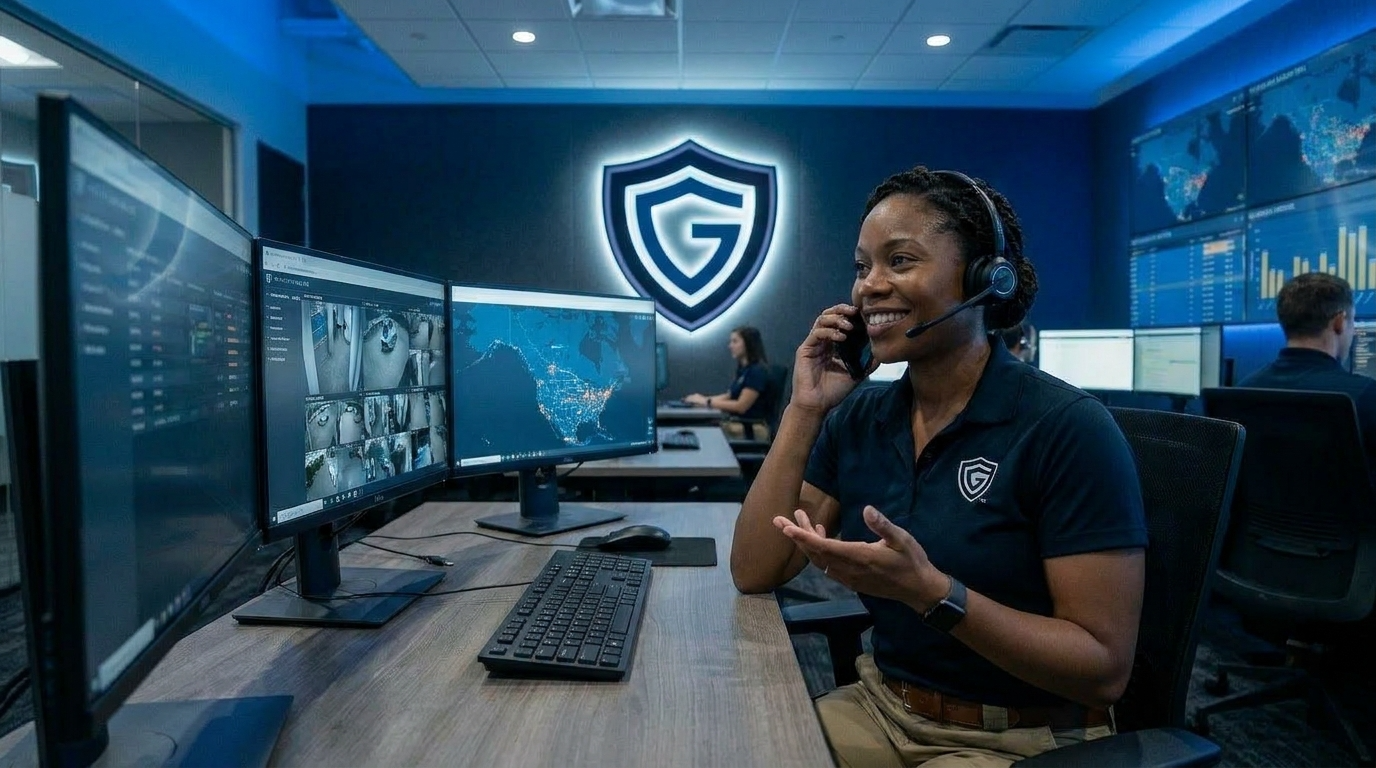
A white-label SOC lets your guard company offer 24/7 operator coverage under your own name, without hiring and running an operations center yourself. Your officers and clients deal with your company. The operators behind the calls work for a shared SOC you partner with.
This post covers what a white-label SOC does for a guard company, what its monitoring includes, how staffing works, how SOC as a service works, what building your own takes, and the questions to ask before you choose a partner.
What is a white-label SOC for a guard company?
A white-label SOC is a staffed operations center that answers, dispatches, monitors, and documents for your company, under your company’s name. Your clients never see a second brand.
For a guard company, the work is operational, not IT security. The operators handle:
- 24/7 call answering from your officers, your clients, and the public
- Officer dispatch and coordination
- Guard tour and check-in monitoring so no officer goes silent for hours
- Remote patrols of client camera systems
- Incident response and escalation, following each account’s written protocol
- Time-stamped documentation of every call and incident
What does white-label SOC monitoring include?
White-label SOC monitoring is the live watch over your officers, posts, and client sites that runs between incidents. A good provider covers five areas:
- Guard tour monitoring. Operators watch tour scans in your platform and act when a checkpoint is missed or late.
- Officer check-ins. Scheduled check-ins by call or app. A missed check-in triggers a callback, then escalation under your protocol.
- Remote patrols. Operators patrol client camera systems on a set schedule and log what they see. See how remote patrols work.
- Remote monitoring. Operators watch client sites and respond to events per each account’s instructions. See remote monitoring for guard companies.
- Manager on Duty support. Operators handle the after-hours calls and escalation decisions your on-call manager would otherwise take at 2 a.m. See live operational support.
If you want to sell camera-based coverage to clients as its own line item, our guide to remote patrols for guard companies explains how it fits into contracts.
Why guard companies use a white-label SOC
One seat, covered around the clock, takes about 5 operators. A week has 168 hours, and a full-time operator works 40. That’s 4.2 operators before anyone takes a vacation, gets sick, or goes to training.
At $22 an hour, the labor for one 24/7 seat runs about $286,000 a year, with a conservative 25% for payroll taxes and benefits. That’s before a supervisor, technology, recruiting, or overtime. A quick rule: your hourly wage times 13,000 gives you the yearly labor cost of one seat.
Use your own local wage when you run this math. For a baseline, the U.S. Bureau of Labor Statistics reports the median annual wage for security guards was $38,020 in May 2025.
A white-label SOC spreads that cost across member companies. You get trained operators on day one instead of after a 6 to 12 month build.
How does white-label SOC staffing work?
The SOC provider hires, trains, schedules, and supervises the operators, so they never sit on your payroll. You skip the five-operator math above, along with recruiting, turnover, and overtime.
Your job is to give the operators what they need to act like your own staff:
- Written post orders for each account
- Escalation contacts and the order to call them
- Access to your field platform so operators see tours, check-ins, and reports
- Client reporting preferences
Ask any provider how many operators are trained on your accounts. If only one person knows your protocols, a single call-out leaves a gap. At Guardian Alliance SOC, every operator completes 36 hours of training.
How it works with your brand
Operators answer under your company name and follow your protocols for each account. They work in the field platforms your officers already use, such as TrackTik, Belfry, Therms, StaffWizard, and ES Chat. Reports go to you and your clients in your format.
To your client, it looks like your company has a professional operations center. In practice, it does.
What is white-label SOC as a service?
White-label SOC as a service means you get trained operator coverage as an ongoing service instead of building and staffing your own center. You add coverage when you win accounts, without adding headcount.
When you compare providers, get clear answers on four points:
- Which field platforms operators already work in
- Which services are included, such as monitoring, remote patrols, and incident reports
- What onboarding involves and who runs it
- How you scale coverage up or down as you add accounts
What it costs compared to building your own
| Build in-house | Answering service | White-label SOC | |
|---|---|---|---|
| Yearly cost | $286K+ per seat | Lowest | Shared across members |
| Time to run smoothly | 6 to 12 months | Days | Weeks |
| Security-trained operators | You hire and train | Usually not | Yes |
| Works in your field platforms | Yes | Usually not | Yes |
| Incident escalation | You build it | Limited | Built to your protocol |
| Hiring, turnover, QA | Yours | Theirs | Theirs |
Building in-house can still be the right call if you have the interaction volume to keep several seats busy and the management depth to run them. The point is to decide with the full numbers in front of you.
Questions to ask any white-label SOC provider
- How many hours of training do operators get?
- Which of our platforms do they already use?
- Who handles escalations, and how?
- What happens when an operator calls out?
- Do they answer under our company name?
- What reports do we and our clients receive?
- How does coverage scale as we add accounts?
- Who runs onboarding, and how long does it take?
Questions 3 and 4 separate strong partners from weak ones. If you don’t get a clear, specific answer, that tells you what you need to know.
How Guardian Alliance SOC handles it
Guardian Alliance SOC is a shared SOC built by security company owners. It formed when two independently built SOCs merged into one operations center in Dallas, live since July 15, 2026.
Every operator completes 36 hours of training. Operators work in TrackTik, Belfry, Therms, StaffWizard, and ES Chat, answer under your name, and escalate every incident according to your protocol. Coverage includes Manager on Duty support, guard tour and check-in monitoring, remote patrols, remote monitoring, after-hours call handling, and incident reporting. See the full list of SOC services for guard companies.
Frequently asked questions
Is a white-label SOC the same as a dispatch service?
No. A dispatch service routes calls and sends officers. A white-label SOC also monitors guard tours and check-ins, runs remote patrols, makes escalation decisions under your protocol, and writes incident reports for you and your clients.
Will my clients know I use a white-label SOC?
Operators answer under your company name and reports go out in your format, so your clients deal with your brand. Whether you tell clients about the partnership is your decision.
Does a white-label SOC for guard companies handle IT or network security?
No. It handles physical security operations: officers, posts, client sites, and incidents. It does not monitor computer networks.
Can a small guard company use a white-label SOC?
Yes. Operators are shared across member companies, so you get 24/7 coverage without hiring the five operators one in-house seat needs. You add coverage as you win accounts.
What do I need to provide to get started?
Post orders, escalation contacts, platform access, and client reporting preferences for each account. The clearer your protocols, the faster operators can act like your own staff.
Want to run the numbers on your own operation? Book a 30-minute call with Guardian Alliance SOC, or read more answers on our FAQ page.