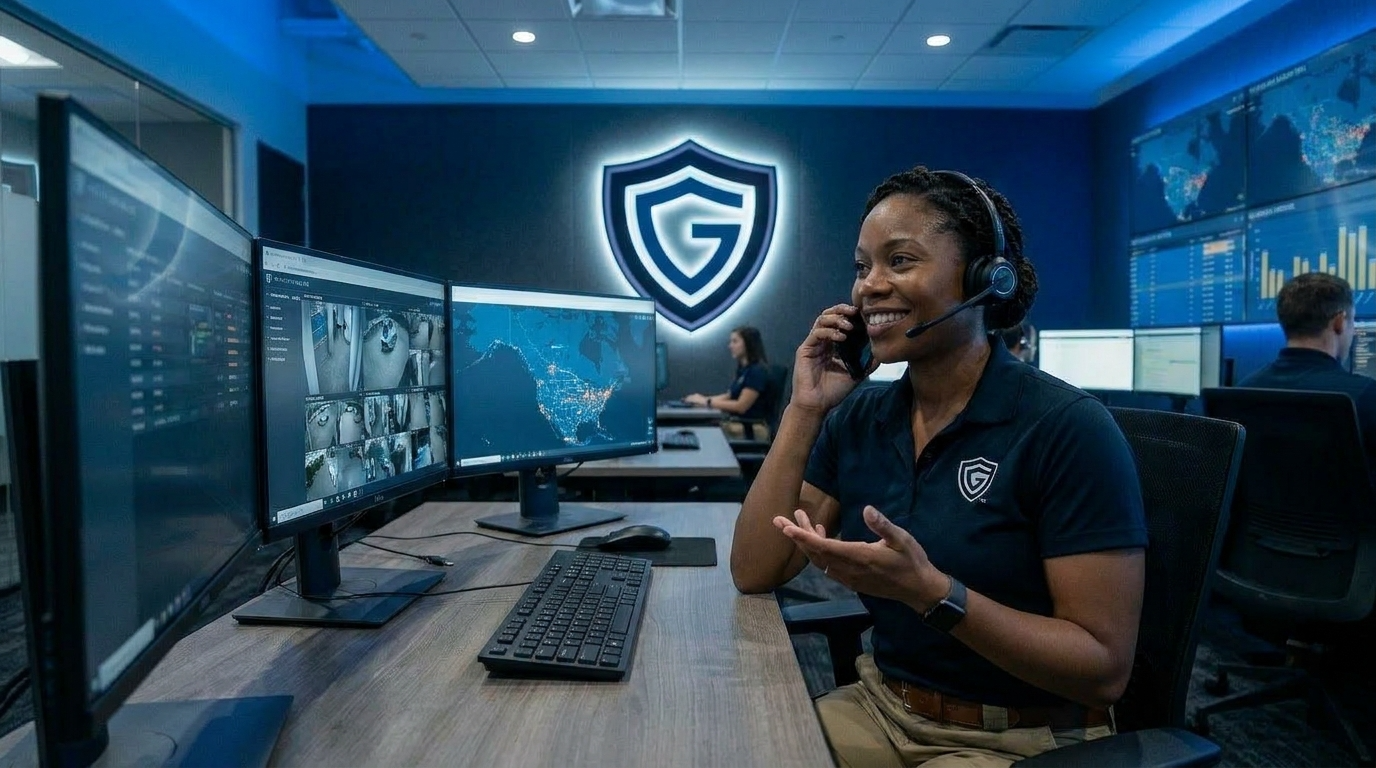
GSOC security is the work of a global security operations center (GSOC), a central room where operators monitor alarms, cameras, people and events across many sites and coordinate the response. A SOC does the same core work for a region or a single company, and for most private security guard companies a SOC, often a shared one, is the right fit.
Here is what each term means and which model fits your guard company.
What does GSOC stand for in security?
In physical security, GSOC stands for global security operations center. HiveWatch describes a GSOC as “a facility that is tasked with monitoring and responding to security events on a global scale.”
SOC stands for security operations center. In the guard industry, a SOC is the room, or the team, that watches your posts and officers in real time and acts when something goes wrong.
What does a GSOC do?
A GSOC collects information from many sources, decides what matters, and starts the response. Based on descriptions from AlertMedia, HiveWatch and Allied Universal, a GSOC typically handles these jobs:
- Monitors cameras, alarms and access control across every site.
- Takes calls for help from the field and starts emergency response.
- Communicates with guards, law enforcement and other responders during an incident.
- Tracks traveling employees and executives and supports executive protection teams.
- Shares time sensitive intelligence, such as severe weather near a site.
- Coordinates regional SOCs and local security teams so they follow one set of procedures.
What is the difference between a GSOC and a SOC?
The main difference is scope. AlertMedia puts it simply: “The key differentiator between them and regular SOCs is in the name: global.” A SOC fits a company with one region or a limited number of locations. A GSOC coordinates many SOCs and sites for an enterprise.
| Factor | GSOC | SOC | Shared SOC for guard companies |
|---|---|---|---|
| Who owns it | A large corporation or institution | A single company or region | A provider that serves many guard companies |
| Sites covered | Many sites, often in several countries | One region or a set of local sites | Each member’s client sites |
| Main inputs | Cameras, alarms, travel data, threat intelligence | Cameras, alarms, officer check-ins | Officer check-ins, guard tours, cameras, client calls |
| Main users | The owner’s security department | The owner’s security or operations team | The guard company’s managers, officers and clients |
| Staffing | Built and staffed by the owner, or outsourced | Built and staffed by the owner | Staffed by the provider’s operators |
What does a GSOC operator do?
A GSOC operator watches incoming alerts and moves each one from identification to escalation to response. On a typical shift, an operator reviews alarms, checks camera and access control health, calls guards or police when needed, and writes reports on what happened.
Allied Universal notes that as automation handles routine responses, GSOC work calls for more critical thinking, communication and writing. A guard company SOC is the same. Operators make judgment calls on call-offs and missed check-ins, and they write the reports your clients read.
Does a guard company need a GSOC or a SOC?
Most guard companies need SOC coverage, not a GSOC. A GSOC solves an enterprise problem: one corporation coordinating its own sites, travelers and intelligence worldwide. Your problem is different. You need someone awake and accountable for every post, every shift, every night.
Ask yourself these five questions:
- Who answers when an officer calls off at 2 a.m., and how fast is the post filled?
- Who notices when an officer misses a check-in or skips a guard tour checkpoint?
- Who picks up after-hours client calls and decides whether to wake a manager?
- Who writes the overnight report your clients and account managers see in the morning?
- Can you staff that desk 24 hours a day, 7 days a week, including holidays and sick days?
If the honest answer to most of these is “a supervisor’s cell phone,” you have a SOC gap. You can close it by building your own operations center or by joining a shared SOC built for guard companies.
Building your own means you own the facility, hiring and training. The Security Executive Council’s guidance on establishing a GSOC lists the same planning steps any operations center needs: a current state assessment of every site, a business case, procedures, technology and a primary and backup location.
What should a SOC do for a guard company?
A SOC for a guard company should run your overnight and after-hours operation, not only answer the phone. Many owners start by searching for a security dispatch service. Dispatch is one piece. The bigger value comes from operators who make decisions and follow them through.
At Guardian Alliance SOC, live operational support with a Manager on Duty (MOD) is the lead service. Operators handle shift checks, GPS and guard tour monitoring, call-off coverage, escalation by your protocols, after-hours client calls and overnight reports. As the MOD page puts it, “Dispatch handles the volume. MOD manages the operation.”
When you compare options, check these details:
- Platforms: operators should work inside the tools you already use, such as TrackTik, Belfry, Therms, StaffWizard and ES Chat.
- Training: every Guardian Alliance operator completes 36 hours of training before handling calls independently.
- Services: look for remote patrols, remote monitoring, incident escalation and reporting under one roof.
- Branding: operators should work under your company’s name so your clients see one team.
If you want to sell camera-based services too, read our guide to remote patrols for guard companies.
How do client GSOCs affect your guard contracts?
Large clients often run their own GSOC, and your officers on their sites will report into it. Before a contract starts, ask the client’s security team three things: how their GSOC wants incidents reported, which events need a call versus a written report, and who on their side owns escalation. Put the answers in your post orders.
With a SOC behind your officers, operators become the after-hours contact for the client’s GSOC.
Frequently asked questions
What is GSOC security?
GSOC security is the work of a global security operations center. Operators monitor alarms, cameras, people and events across many sites and coordinate the response from one location.
Is a GSOC the same as a SOC?
They do the same core work at a different scale. A GSOC coordinates many sites and often several SOCs for a large organization. A SOC covers one company or region.
What does a GSOC operator do?
A GSOC operator reviews incoming alerts, decides what needs action, and contacts guards, police or managers. The operator also documents each event in a report.
Does a security guard company need its own SOC?
You need SOC coverage, but you do not have to build it. A shared SOC gives you trained operators around the clock without building a facility or hiring a night desk.
Is a SOC the same as a dispatch service?
No. Dispatch relays calls and messages. A SOC built for guard companies also monitors check-ins and guard tours, covers call-offs, makes escalation decisions and writes incident reports.
Want SOC coverage for your guard company without building a GSOC? Talk with Guardian Alliance SOC about how operators can support your posts tonight.