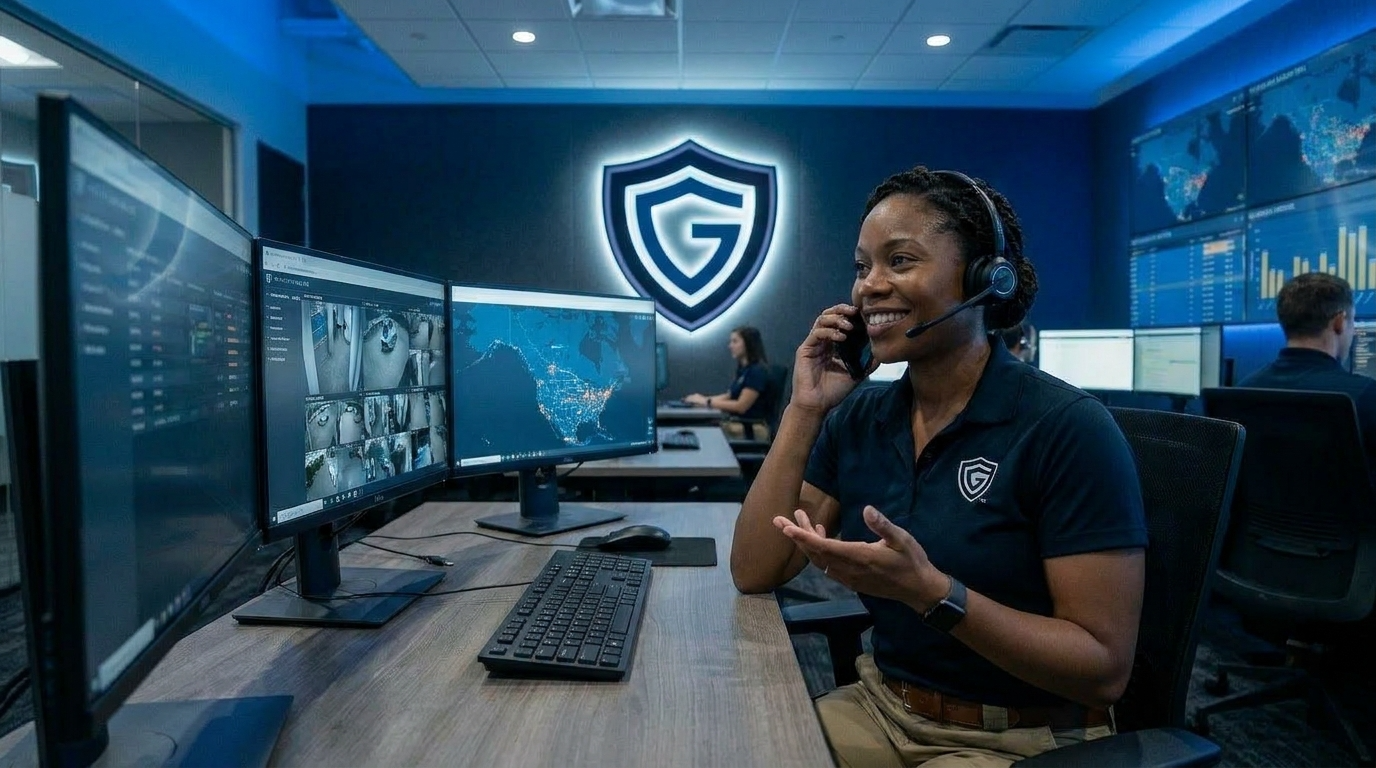
Remote patrols are a security service where trained operators check a property through its cameras, verify what they see, and act on it with a spoken warning, a call to the client, or a call to police. For a guard company, they are a way to cover sites, hours and gaps that a full-time officer does not cover, often with cameras the client already owns.
This guide covers what remote patrols and remote monitoring include, how they compare to dispatch, and what to set up before you sell them.
What does a remote patrol program include?
A remote patrol program combines cameras, video analytics, a security operations center and trained people who decide what to do. Software can flag possible threats, but an operator reviews each one and chooses the response.
In practice, a remote patrol program for a guard company usually has these parts:
- Cameras with remote access and clear enough images to identify activity.
- Analytics that flag motion, loitering or entry into restricted zones.
- Scheduled camera patrols, where an operator checks every camera at set times.
- Two-way audio, so the operator can talk to people on site through speakers.
- A written escalation plan for each site: who to call, in what order, and when to call police.
- A report for every patrol and every incident.
How do remote patrols differ from remote monitoring and dispatch?
Remote patrols and remote monitoring are the two ways an operator watches a site. Dispatch is a separate communications job. The table shows the difference.
| Service | What starts the work | What the operator does | Best fit |
|---|---|---|---|
| Remote monitoring | An alert from cameras or analytics | Verifies the alert, then follows the site protocol | Sites with good analytics and a clear response plan |
| Remote patrols | A set schedule | Logs in and checks every camera, even with no alert | Quiet sites, overnight hours, gaps between physical rounds |
| Patrols plus monitoring | Both of the above | Patrols on schedule, verifies alerts, talks down and escalates | Clients who want coverage without a full-time post |
| Dispatch | A call or radio message from an officer or client | Answers, logs and routes the call, then escalates | Guard companies that need someone on the phones 24/7 |
A shared security operations center (SOC) can run all four from one desk. At Guardian Alliance SOC, operators handle dispatch calls, but they also run remote monitoring, scheduled remote patrols, Manager on Duty shift oversight, guard tour and check-in monitoring, and incident reporting.
How does a remote patrol work, step by step?
A remote patrol is a scheduled walk of the property through its cameras, done by a person instead of software. Here is how a typical patrol runs:
- At the scheduled time, the operator logs in to the client’s camera system.
- The operator reviews each camera and zone in a fixed order, the same way an officer walks a route.
- The operator confirms gates, doors, lots and perimeters look secure, or flags anything out of place.
- If something is wrong, the operator follows that site’s protocol: talk down through speakers, call the client contact, send a local officer, or call police.
- The operator files a patrol report, plus a separate incident report if anything happened.
How often should patrols run? Guardian Alliance SOC recommends once per hour as a starting point.
When should a guard company add remote patrols to a contract?
Add remote patrols when a client needs eyes on a site during hours or areas where a full-time officer is too costly or not required. Common cases:
- Overnight coverage at warehouses, industrial yards and retail sites after close.
- Parking lots and common areas at residential complexes and HOAs.
- Checks between a mobile officer’s physical rounds.
- Short-term coverage when an officer calls off and you cannot fill the post.
- Hybrid bids, where you pair an officer on the busy shift with remote coverage on the quiet one.
It is the wrong fit when post orders require a person on site to check IDs, open gates, or respond physically. It also fails when the client’s cameras lack remote access or the image quality is too poor to tell what is happening.
What do you need before you sell remote patrols?
You need working camera access, a written response plan for each site, and trained operators on shift 24/7. Use this checklist before you quote:
- Confirm the cameras allow remote access and cover entrances, perimeters and high-risk zones.
- Check for speakers if the client wants talk-down.
- Write a call tree for each site: client contacts, your supervisor, local officer, police.
- Agree on patrol frequency and what counts as an incident.
- Decide how you will price it, by patrol time, by site, or bundled with officer hours.
- Check your state’s licensing rules. You stay the licensed provider of record for your client.
- Set the report format your client will receive after each patrol and incident.
Some larger clients ask about standards. UL created the UL 827B listing for managed video monitoring services and, as Security Systems News reported, issued the first listing in October 2016.
Should you build a remote patrol desk or use a shared SOC?
Build your own desk if you have enough camera sites to keep operators busy every hour of every night. Use a shared SOC if you do not, because you still need a trained person awake at 3 a.m. for the one alert that matters.
Building means hiring and training operators for every shift, covering call-offs, and keeping backup power and internet. A shared SOC spreads that cost across many guard companies. Guardian Alliance SOC operators complete 36 hours of training, work inside the platforms you already use, such as TrackTik, Belfry, Therms, StaffWizard and ES Chat, and answer under your company name. Our earlier post on white-label SOC services for security guard companies covers how the branding works.
Frequently asked questions
Are remote patrols the same as remote monitoring?
No. Remote monitoring starts when a camera or analytics alert fires. Remote patrols run on a schedule, so an operator checks every camera even when nothing has triggered an alert. Most sites benefit from both.
Can remote patrols replace an on-site officer?
On some low-activity sites, yes. On most contracts, it works best alongside officers, covering hours or areas a post does not. Operators cannot physically intervene, so they rely on talk-down, the client contact, a local officer or police.
Do my clients need new cameras?
Usually not. The system needs remote access, good placement and image quality clear enough to see what is happening. No specific camera brand is required.
Will my clients know a third party is watching their site?
Not unless you tell them. Guardian Alliance SOC works behind the scenes under your brand and only through you. See the Guardian Alliance SOC FAQ for details on white-label service.
Want to add camera coverage to your next bid without hiring a night desk? Talk with Guardian Alliance SOC about remote patrols, remote monitoring and 24/7 operator support for your sites.